
Filming interviews at events is not always a structured process. It depends on how participants are sourced and where interviews take place. These factors determine how interviews are recorded and what can be used in the final video.
What Makes Event Interviews Different
Participants are approached in three ways. Some are contacted before the event and asked to provide a testimonial. Others are identified during the event based on who the client wants to feature. In some cases, people are approached on the spot, such as attendees coming out of sessions or moving through the event.
Where Interviews Are Filmed at Events
Interview location depends on how the client wants testimonials handled and how participants are being sourced.
Exhibit booths / expo floor
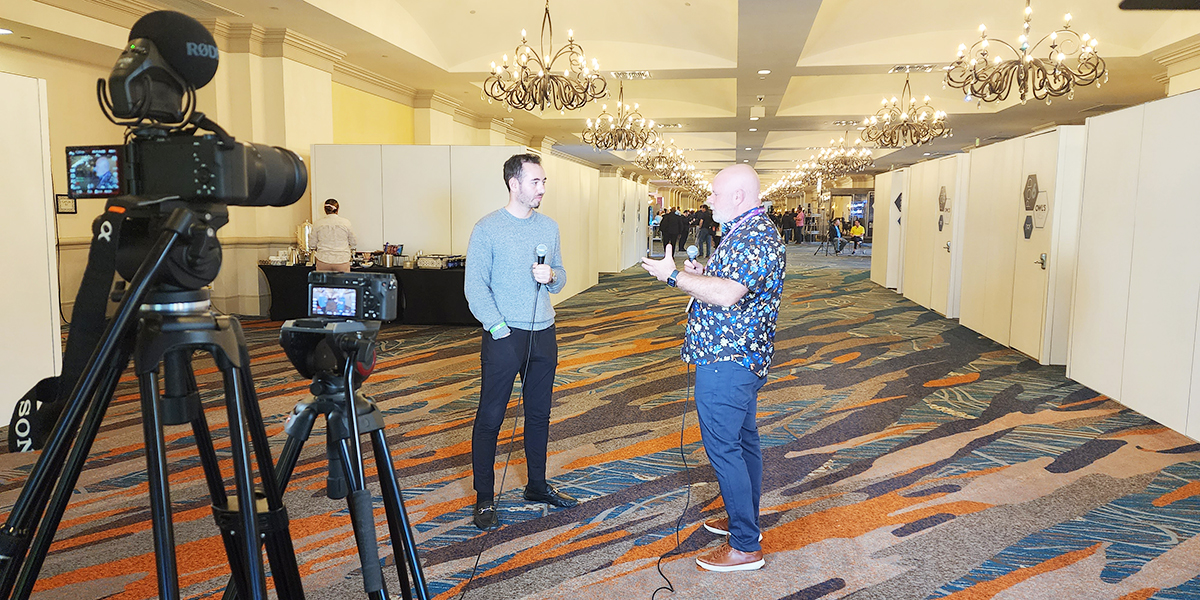
If the client is an exhibitor, interviews may be filmed at their booth. In other cases, interviews happen across the show floor as participants are identified and approached.
Hallways / common areas
When no specific location is set, interviews take place wherever participants are available, including quieter areas when possible.
Meeting rooms or reserved spaces
Some clients set aside a dedicated room or area where participants are brought for interviews.
Interview Setup for Event Interviews
Setup follows how interviews are organized during the event.
When interviews happen across multiple areas, the setup is moved and rebuilt between participants.
When interviews are handled in one location, the setup remains in place and participants are brought in, allowing interviews to happen back-to-back with fewer adjustments.
How Interviews Are Managed During Events
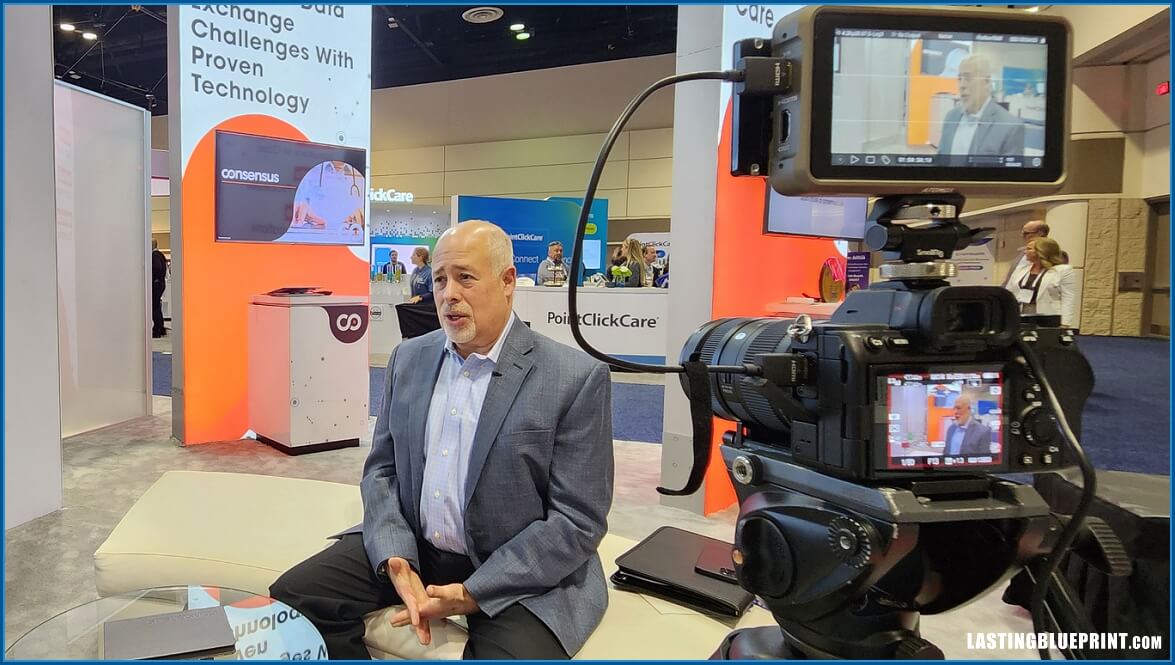
Once a participant is ready, interviews move quickly.
Filming typically begins shortly after setup, without extended preparation.
A client or team member usually asks the questions, with the direction shaped by how the conversation unfolds rather than a fixed script. Follow-up questions are used to clarify or expand responses when needed.
This approach also affects how natural responses feel on camera, which is covered in How Testimonial Videos Are Filmed to Sound Natural.
This approach allows interviews to happen efficiently, but it also means responses are not always consistent across participants.
The types of questions used during these interviews also affect response quality, as outlined in Testimonial Questions to Ask Event Attendees.
How Event Interviews Affect the Final Video
Event interviews do not produce consistent responses across every participant.
Responses vary from participant to participant. Some participants think through their answers while speaking, some require follow-up questions to stay clear or complete, and others may not give a strong or usable response. In contrast, some participants deliver clear, usable responses without much guidance.
This leads to variation between interviews in both pacing and clarity.
Because of this, more interviews are recorded than are used. During editing, stronger responses are selected while weaker or unclear ones do not make the final cut.
The final video is built from the most usable portions of each interview.
What Clients Should Expect from Event Interviews
In event environments, it is realistic to record around 10 to 20 interviews in a full day when testimonials are the focus. A more detailed breakdown of volume and selection is covered in How Many Testimonial Videos Can Be Filmed in One Day.
How many are used depends on the type of video being created.
For a single highlight video, around 5 to 7 interviews are typically selected.
At events, target numbers are not always reached. Availability depends on the event schedule, participant interest, and how interviews are coordinated throughout the day.
When a fixed number becomes the goal, participants may be chosen quickly just to reach that target, which lowers the overall quality of responses.
Recording more interviews increases options, not guaranteed results. More footage does not mean more usable content, since only the strongest responses are selected during editing.
A more reliable approach is to plan for variation. If the goal is to capture 5 strong testimonials, it helps to account for cancellations, weak responses, or changes during the event, regardless of how participants are sourced.
The goal is not to hit a number—it is to capture enough strong responses to build the final video.
Conclusion
Event testimonial interviews are shaped by how the event is run, how participants are sourced, and how interviews are handled throughout the day. Results are not driven by a fixed process, but by how those conditions are managed in real time when producing testimonial videos.